Introduction
Picture this: your boat takes on water at Elephant Butte Lake, drifts into deeper water, and sinks before you can do anything about it. You call your insurer expecting a straightforward payout, then learn that raising and removing the wreck could cost thousands more.
That's where salvage coverage comes in, and it's one of the most misunderstood parts of a boat insurance policy. Many owners confuse it with towing, assuming their roadside-style assistance plan handles a sunken or grounded vessel. It doesn't.
This guide breaks down what salvage coverage actually pays for and how insurers calculate a total-loss settlement when salvage costs enter the picture. It also covers what happens if you want to keep a wrecked boat instead of surrendering it.
Key Takeaways
- Salvage coverage pays to recover a wrecked boat, part of hull coverage, not towing
- Payouts differ significantly between Agreed Value and Actual Cash Value policies once salvage costs apply
- Owners can sometimes keep a totaled boat's wreck, but insurers deduct its salvage value and brand the title
- Salvage-titled boats are harder to insure and often qualify for liability-only coverage
What Is Salvage Coverage in Boat Insurance?
Salvage coverage pays for the costs of recovering, raising, or removing a boat that has sunk, run aground, or wrecked. It's separate from the cost of repairing the boat itself.
Two terms get mixed up constantly, so let's separate them:
- Salvage charges — what it costs to recover the vessel (divers, cranes, pumps, tow boats)
- Salvage value — what the damaged wreck is worth afterward, whether sold for parts or scrap
Most standard boat and marine insurance policies bundle salvage charges into hull or physical damage coverage. But that's not universal. Some carriers exclude it entirely or attach specific conditions, so confirming the details with your provider matters more than assuming it's automatic.
A quick example: Say your boat is insured for a hull value of $40,000. It sinks at the dock and requires $6,000 in recovery costs before anyone can even assess the damage.
With salvage coverage, your policy pays that $6,000 on top of repair or replacement costs, up to your insured value. Without it, that bill lands squarely on you.
Salvage Coverage vs. Towing Coverage
Towing and salvage sound similar. They're not.
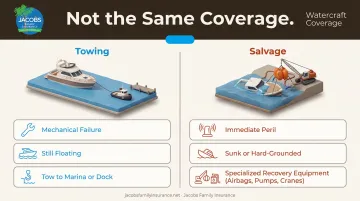
- Towing covers a disabled but still-floating boat that needs help getting to a marina or dock, typically due to mechanical failure
- Salvage covers a boat facing immediate peril, meaning it has sunk, grounded hard, or needs specialized equipment like airbags, pumps, or cranes to recover
According to BoatUS's towing FAQ, a breakdown or soft grounding without immediate danger counts as towing. Sinking, hard grounding, or anything requiring salvage equipment falls under a completely different coverage provision, and a towing membership won't pay for it.
Since salvage falls under its own coverage terms, insurers typically cap payouts at your boat's full insured value, sometimes with a separate dollar limit stated on your declarations page. Check your specific policy. The number varies by carrier and isn't standardized across the industry.
How Salvage Payouts Work When a Boat Is Totaled
Insurers generally declare a boat a total loss when:
- Repair costs alone exceed the boat's insured value
- Combined salvage and repair costs exceed that value
- Structural damage leaves the vessel unseaworthy, regardless of repair cost
How much you actually receive depends heavily on your policy type.
| Policy Type | How It Pays | Impact of Salvage Costs |
|---|---|---|
| Agreed Value | Pays the pre-agreed amount, no depreciation | Salvage costs are added on top, up to that agreed figure |
| Actual Cash Value (ACV) | Pays current market value, minus depreciation | Lower baseline payout means salvage costs eat into an already-reduced settlement faster |
According to the Triple-I's boat insurance overview, ACV settlements rely on used-boat pricing guides and current market data to calculate depreciation, while Agreed Value payouts stick to the number set when you bought the policy.
Worked example: A boat with a $35,000 agreed value sinks in a lake. Recovery costs run $8,000. Repair estimates come in at $30,000. Combined, that's $38,000, more than the boat is worth. The insurer declares it a total loss and pays the $35,000 agreed value.
What Salvage Retention Looks Like
If you want to keep the wreck instead of surrendering it, insurers subtract its salvage value from your payout.
Say that same $35,000 boat's wreck is worth $5,000 to a salvage buyer. If you retain it, your settlement drops to $30,000, and you take possession of what's left.
One more thing owners often overlook: wreck removal can be a legal obligation, not just a policy option. Federal law under 33 U.S.C. § 409 requires owners to mark and remove vessels wrecked in navigable channels.
Many policies cap wreck removal coverage at the boating liability limit listed on your declarations page. It's worth confirming that number before you ever need it.
How to Claim Salvage Rights on a Boat
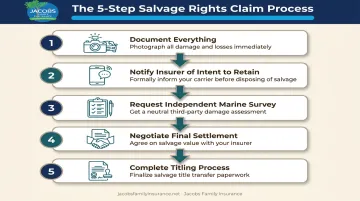
If your boat sinks or wrecks and you want to keep the salvage, follow these steps in order:
- Document everything immediately. Take photos and notes of the damage before the boat is moved, altered, or exposed to further deterioration.
- Notify your insurer early about your intent to retain the wreck. This changes how the adjuster approaches your settlement calculation from the start.
- Request an independent marine survey. This verifies that the salvage value the insurer proposes to deduct is accurate, not just a lowball estimate.
- Negotiate the final settlement. The agreed salvage value gets subtracted from your total-loss payout, and legal possession of the wreck transfers to you.
- Complete your state's titling process to obtain a branded salvage or rebuilt title. In New Mexico, this means applying for a salvage title through the Motor Vehicle Division, which permanently flags the vessel's title and registration record. Requirements and paperwork can vary, so confirm current forms directly with the MVD before you file.
Once you retain salvage, responsibility for wreck removal, storage, and any environmental cleanup typically shifts to you, unless you've negotiated otherwise with the insurer beforehand.
Salvage Titles, Exclusions & Coverage Limitations
Insuring a Boat With a Salvage Title
Because salvage titles often signal hidden prior damage, many insurers respond by offering:
- Liability-only coverage instead of full physical damage protection
- Higher premiums to offset unknown prior damage
- Outright refusal from carriers unwilling to underwrite the risk at all
Your best move if you're buying or insuring a salvage-titled vessel: get a professional marine survey and gather complete repair records. A documented repair history gives underwriters something concrete to evaluate instead of guesswork, and it often opens the door to better terms.
What Salvage Coverage Typically Excludes
Standard salvage provisions leave gaps too, and common exclusions include:
- Routine relocations that don't involve peril or emergency recovery
- Damage from neglect, wear and tear, or gradual deterioration
- Incidents that happen outside your policy's stated navigation limits
- Standard deductibles, which typically apply before coverage kicks in
One exclusion deserves special attention: fuel spills or pollution cleanup after a sinking are handled differently depending on the carrier. Some policies build spill containment into the base coverage; others require a separate environmental liability endorsement. Don't assume either way; ask your agent directly.
Protecting Your Boat With the Right Local Coverage
New Mexico is landlocked, but that doesn't mean boat owners here are immune to salvage, towing, and total-loss risks. Popular boating spots like Elephant Butte Lake, Navajo Lake, and Cochiti Lake see their share of hard groundings, sudden sinkings, and storm damage every season, which is exactly where local expertise matters.
At Jacobs Family Insurance, we're a local, family-owned Allstate Elite agency serving Santa Fe and communities across northern New Mexico. We review existing or new boat policies to confirm that salvage, towing, and total-loss protections actually match how and where you use your boat, not a generic template.
That review includes checking:
- Confirming whether salvage charges are bundled into your hull coverage or excluded
- Comparing your wreck removal limit against real recovery costs at your boating location
- Assessing whether bundling your boat with an existing auto or home policy could lower your overall premium

You won't get a call center. You'll get a neighbor who answers the phone.
Ready for a boat insurance review or quote? Call Jacobs Family Insurance at (505) 557-2067, stop by our office at 1547 South St. Francis Drive, Santa Fe, NM 87505, or request a quote online. We're open Monday through Saturday, 9:00 AM to 5:00 PM.
Frequently Asked Questions
Does boat insurance cover salvage?
Most standard boat policies bundle salvage charges with hull coverage, but this isn't universal. Availability, limits, and whether it's automatic or optional vary by insurer, so confirm the specifics with your agent.
What do insurance companies do with totaled boats?
Insurers typically take possession of the wreck and sell it for salvage value after paying your claim. If you retain the wreck instead, insurers subtract that salvage value from your Agreed Value or ACV settlement.
How do I claim salvage rights on a boat?
Notify your insurer early that you want to keep the wreck, get an independent marine survey to verify its value, and negotiate the salvage deduction before finalizing your settlement.
What's the difference between salvage value and salvage charges?
Salvage charges are the cost of recovering a damaged vessel, like hiring divers or cranes. Salvage value is what the wrecked boat itself is worth afterward, whether sold for parts or scrap, according to IRMI's insurance glossary.
Can I insure a boat with a salvage title?
Yes, but it's harder. Many insurers limit coverage to liability-only, charge higher premiums, and require a marine survey before offering terms.
Is towing coverage the same as salvage coverage?
No. Towing covers a disabled but floating boat needing help getting to safety. Salvage covers recovering a sunk, grounded, or wrecked vessel, usually under a completely different policy provision.