
Sound far-fetched? It happens more often than most condo owners realize. Many assume their HOA's master insurance policy handles every shared-property loss. It doesn't always. When that policy runs short, the bill gets divided up and mailed straight to owners.
This guide breaks down what loss assessment coverage actually does, when it kicks in, how much you should carry, and how to make sure your HO6 policy won't leave you scrambling for cash after your association's next claim.
Key Takeaways
- Loss assessment coverage reimburses your share of an HOA special assessment after a covered loss.
- Standard HO6 policies typically build in just $1,000 to $2,000 of protection, rarely enough for a real assessment.
- Fire, storm damage, liability judgments, and high master-policy deductibles are the most common triggers.
- A local agent can review your master policy and match your limit to your building's actual risk.
What Is Loss Assessment Coverage for Condos?
Loss assessment coverage is an endorsement on an HO6 condo insurance policy. It reimburses you for your portion of a special assessment, a one-time or installment charge your condo association bills owners when its master policy payout and reserve funds don't fully cover a loss.
Most HO6 policies include a small base amount of this coverage automatically. You can typically raise the limit for an added premium.
How a Special Assessment Gets Divided
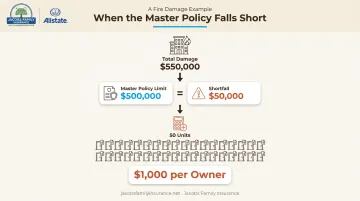
Here's how it plays out: a fire causes $550,000 in damage to shared building structures, but the association's master policy caps out at $500,000.
That leaves a $50,000 shortfall, split across 50 units, according to Allstate's breakdown of condo loss assessment coverage. Each owner receives a $1,000 bill.
If your HO6 policy carries loss assessment coverage at or above that amount, it reimburses your $1,000 share. Without it, that cost comes straight out of your pocket.
Loss assessment coverage acts as the gap filler between what your association's master policy pays and what eventually lands on individual owners.
Covered vs. Excluded Causes
This coverage generally responds only when the assessment stems from a peril your policy already insures against. That distinction matters:
Typically covered:
- Fire or wind damage to shared roofs, hallways, or structures
- Storm damage exceeding the master policy's limit
- Liability judgments from injuries in common areas
- Association's insurance deductible on a covered claim
Typically excluded:
- Underfunded reserve accounts
- Routine maintenance like repainting or repaving
- Aging roof replacement due to normal wear and tear
Common Situations That Trigger a Condo Loss Assessment
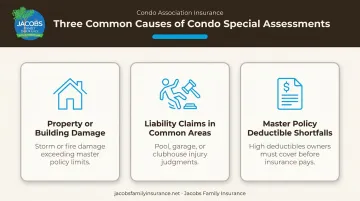
Special assessments don't come out of nowhere. They usually trace back to one of three scenarios.
Property or Building Damage
Shared structures like roofs, hallways, and elevators are expensive to repair, and master policies have limits. When storm or fire damage exceeds that ceiling, the board has to make up the difference somehow. That "somehow" is usually a special assessment split among every unit owner.
Liability Claims in Common Areas
Someone slips by the pool. Someone falls in the parking garage. If a liability judgment exceeds the association's liability coverage, the shortfall gets passed to owners, according to guidance from the National Association of Insurance Commissioners. Clubhouses, gyms, and shared stairways are frequent settings for these claims.
Master Policy Deductible Shortfalls
Condo association master policies often carry high deductibles, sometimes far higher than a typical homeowner's policy. When a claim hits, someone has to cover that deductible before insurance pays a dime. Boards sometimes assess owners directly just to clear that hurdle, even on claims where the master policy eventually pays out in full.
Does Your HO6 Condo Policy Already Include Loss Assessment Coverage?
Most HO6 policies include a modest built-in amount of loss assessment coverage, commonly $1,000 to $2,000. That sounds reasonable until you compare it against the example above, where a single fire generated a $1,000-per-unit bill and left zero cushion for anything else.
Here's a detail many owners miss: this coverage typically responds based on when the assessment is issued, not when the original damage happened. That means:
- If your building suffered damage before you closed on your unit, but the HOA doesn't issue the assessment until after you own it, you could be on the hook.
- The policy in force on the assessment date is the one that matters, not whatever coverage the previous owner had.
- Ask the HOA for any pending or recent assessments before closing, since timing gaps like this rarely show up in standard closing paperwork.
Action step: Pull out your policy's declarations page or call your agent. Confirm your current limit and ask whether it can be raised through an endorsement. Five minutes on the phone now beats a surprise bill later.
How Much Loss Assessment Coverage Should You Carry?
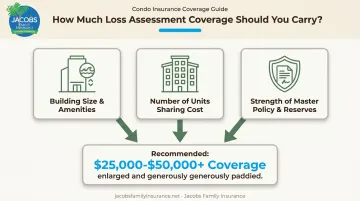
Additional loss assessment coverage typically ranges from $10,000 up to $100,000 or more, depending on the insurer, according to Policygenius. Picking the right number depends on a few things specific to your building:
- Building size and amenities: High-rises with pools, elevators, and clubhouses carry more assessment risk than a small four-unit walk-up. More shared infrastructure means more that can go wrong.
- Number of units sharing the cost: Surprisingly, fewer owners means a bigger slice per person when an assessment hits. A 10-unit building splitting a $50,000 shortfall pays far more per owner than a 200-unit complex splitting the same amount.
- Strength of the master policy and reserves: Well-funded associations with strong reserves and solid master policy limits rarely need to assess owners beyond routine maintenance. A poorly funded association is a different story.
Before choosing a limit, request a copy of your association's master policy summary and its most recent reserve study. These documents tell you far more about your actual risk than guesswork, and a local agent can help you interpret what they mean for your specific building.
Many independent agents recommend starting no lower than $25,000 to $50,000 for most condo owners, adjusting upward for larger or amenity-heavy buildings. Raising your limit from the base $1,000-$2,000 to something meaningful usually adds only a modest amount to your annual premium, not a dramatic one.
Cost of Loss Assessment Coverage & Getting the Right Policy in New Mexico
Given the financial exposure it protects against, loss assessment coverage is inexpensive. Nationally, added coverage runs roughly $25 to $50 per year, according to Policygenius' guide on loss assessment coverage, for a meaningful bump in protection.
Actual cost depends on:
- The insurer you choose
- The coverage limit you select
- Your building's age, location, and amenities
- Your association's claims history
Worth knowing: under New Mexico law, a valid assessment can become a lien against your unit. If it goes unpaid too long, the association may foreclose that lien similarly to a mortgage. Insurance coverage disputes don't erase that payment obligation, which is exactly why matching your limit to real exposure matters.
This is where local knowledge pays off. Jacobs Family Insurance is a family-owned Allstate Elite agency based in Santa Fe, serving condo owners across Northern New Mexico. Our agents can review your HOA's master policy documents and help you select a loss assessment limit that fits your building, not a generic number pulled from a national average.
No call centers. No scripts. Just a local agent who knows the difference between a downtown Santa Fe condo and a mountain-community building in Taos.
Ready for a free condo insurance review? Call (505) 557-2067, stop by 1547 South St. Francis Drive, or request a quote online. We're open Monday through Friday, 9 AM to 5 PM.
Frequently Asked Questions
Do you have to pay condo assessments?
Yes. Unit owners are obligated to pay special assessments levied by their condo association under the association's governing documents. Failure to pay can result in a lien against your unit and, eventually, legal action.
Are condo special assessments covered by insurance?
Assessments tied to a covered loss, like storm or fire damage, can be reimbursed through loss assessment coverage on your HO6 policy. Assessments for routine maintenance or underfunded reserves typically aren't covered.
What does condo assessment mean?
A condo assessment is a charge from the association to unit owners. Regular monthly dues cover normal operations, while a special assessment is a separate, often one-time, charge for unexpected costs.
How much loss assessment coverage do I need?
The right amount depends on your building's amenities, unit count, and the strength of the master policy. Many insurance agents recommend at least $25,000 to $50,000 in coverage for most condo owners.
Is loss assessment coverage required?
It's usually optional, not mandatory, but strongly recommended. Without it, you're personally exposed to potentially large, unpredictable out-of-pocket costs if your association issues an assessment.
Does loss assessment coverage cover HOA dues increases?
No. This coverage applies to one-time special assessments tied to a covered loss, not to routine increases in your regular monthly HOA dues.