Many drivers find this baffling. If you did nothing wrong, why are you paying anything?
Here's the short answer: not all uninsured motorist (UM) coverage carries a deductible. Bodily injury claims usually don't. Property damage claims often do. This article breaks down what that deductible actually is, why it applies even when the other driver caused the crash, typical amounts in New Mexico, and how to pick the right deductible level for your situation.
Key Takeaways
- UMPD deductibles apply to vehicle repair costs, not injury claims
- UMPD deductibles in New Mexico typically range from $100 to $500, depending on your specific policy and carrier
- The deductible is a term of your own contract, not a penalty for the crash
- Comparing your UMPD and collision deductibles before filing a claim can save you money
- Jacobs Family Insurance can review your policy and confirm your exact deductible amount
What Is an Uninsured Motorist Coverage Deductible?
An uninsured motorist property damage (UMPD) deductible is the amount you pay out of pocket before your insurer covers the rest of a covered vehicle damage claim caused by an uninsured driver.
Here's the distinction that trips most people up: uninsured motorist coverage splits into two parts.
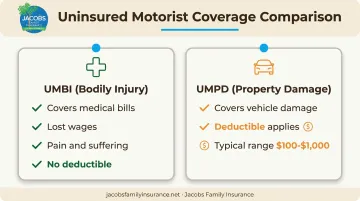
- UMBI (bodily injury): Covers your medical bills, lost wages, and pain and suffering. Progressive notes that UMBI generally carries no deductible at all.
- UMPD (property damage): Covers damage to your vehicle. This is where the deductible usually shows up.
UM/UIM coverage exists for one simple reason: it protects you when the at-fault driver has no insurance, or not enough insurance, to pay for your damages. Many states also offer underinsured motorist (UIM) coverage as companion protection, with its own separate rules and limits.
A Simple Example
Say you have a $500 UMPD deductible and your repair bill comes to $3,000. You pay the first $500, and your insurer covers the remaining $2,500. The math is simple, but understanding why insurers structure it this way takes a bit more explanation.
One more thing worth knowing: most states require insurers to offer UM/UIM coverage by law. You can typically waive it, but only in writing, and only after your insurer confirms you understood what you were giving up.
Why Do You Still Pay a Deductible When the Other Driver Is at Fault?
This is the question that generates the most confusion, and it has a clean answer: your deductible is a term of your contract with your own insurer, not a reflection of who caused the crash.
UM coverage is what's known as "first-party" coverage. You're filing a claim against your own policy, not the other driver's. Why? Because the other driver either has no insurance policy to file against, or their coverage doesn't stretch far enough to pay you back. Your insurer is essentially standing in for the missing coverage the at-fault driver should have carried.
The deductible exists to keep this optional protection affordable: insurers can offer UM coverage at a lower premium because you agree to share a small slice of the risk. That trade-off keeps your monthly rate more manageable than it would be otherwise.
Before you assume the deductible always applies, a few nuances are worth checking with your agent:
- Some insurers or states allow you to waive the UMPD deductible entirely if the uninsured driver is positively identified and confirmed at fault. This varies widely by carrier and state, so don't assume it applies to you.
- If you also carry collision coverage, you may be able to file under whichever deductible is lower. More on that comparison below.
How Much Is a Typical Uninsured Motorist Deductible?
Nationally, UMPD deductibles range from $100 to $1,000, depending on the state and insurer. Some states set a fixed amount by law, while others leave the choice to insurers and drivers.
New Mexico falls into the fixed-amount category. According to the New Mexico Office of the Superintendent of Insurance, uninsured motorist coverage in the state carries a $250 deductible for vehicle damage claims. The underlying statute describes this as an exclusion of no more than the first $250 of property loss per accident, which functions as a ceiling rather than a menu of deductible options.
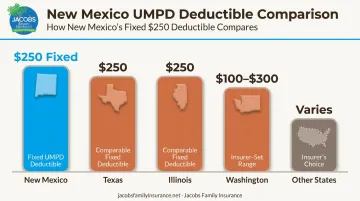
That ceiling detail matters if you're comparing New Mexico's rules to advice written for other states, since deductible structures vary widely:
- Texas and Illinois also use a fixed $250 deductible
- Washington permits up to $100 generally, or up to $300 for certain hit-and-run situations
- Other states let insurers and policyholders choose their own amount
If your New Mexico declarations page shows a different UMPD deductible figure, that's worth a phone call. Confirming your exact amount, and whether it's adjustable, is easiest with a local agent who can pull up your policy directly. Jacobs Family Insurance can walk through your declarations page with you and clarify what you're actually working with.
Is It Better to Choose a $500 or $1,000 Deductible?
This question comes up constantly with collision coverage, and the tradeoff illustrates the same principle behind any deductible decision. Worth noting upfront: New Mexico's UMPD deductible is set by law at $250, so this $500-vs-$1,000 comparison applies to collision coverage, not UMPD. Understanding the general logic still helps, since it's the same math your agent uses when discussing your full policy.
- Higher deductible = lower premium, but more out-of-pocket cost when you file a claim
- Lower deductible = higher premium, but less financial exposure if your car gets hit
The NAIC's consumer guide to auto insurance confirms the general principle: a policy with a $1,000 deductible typically costs less than an otherwise identical policy with a $500 deductible. Actual savings depend on your vehicle, driving history, and insurer.
How to Decide
- Check your emergency savings. Choose a deductible you could pay in cash today without scrambling. If $1,000 would strain your budget, a $500 deductible probably makes more sense even with the higher premium.
- Consider your vehicle's value and age. Newer or higher-value cars tend to have pricier repair bills, so a lower deductible can reduce your exposure when something goes wrong.
- Request quotes at both levels. Numbers on paper beat guessing. Ask your agent for an apples-to-apples comparison before locking in a decision.
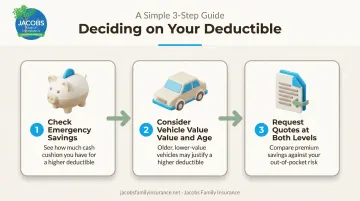
This decision-making process applies directly to your collision deductible, but remember that your UMPD deductible stays fixed at $250 under New Mexico rules. A direct conversation with your agent, rather than a generic online calculator, gives you the clearest picture of how both deductibles work together on your policy.
Uninsured Motorist Deductible vs. Collision Deductible: What's the Difference?
Both deductibles apply to vehicle repair costs, but they come from different coverages with different triggers.
| Feature | UMPD Deductible | Collision Deductible |
|---|---|---|
| Applies when | An identified uninsured driver is at fault | Any collision, regardless of fault |
| Typical amount | $250 in New Mexico; $100–$1,000 nationally | Often $500–$1,000, selected by driver |
| Required by law | Usually, unless waived in writing | Optional |
| Hit-and-run coverage | Often requires driver identification | May cover unidentified hit-and-run |
Notice the different dollar amounts in the table above? That's common — insurers often set UMPD and collision deductibles at different levels on the same policy. If an identified uninsured driver hits you and both coverages could apply, check which deductible is lower before filing.
If you don't carry collision coverage at all, your UMPD coverage may be your only protection against vehicle damage from an uninsured driver. Without it, you'd pay for repairs out of pocket.
Getting the Right Uninsured Motorist Coverage for Your Situation
A quick policy review can save you a headache later. Run through this checklist:
- Confirm your UM/UIM limits: check whether they match your state's minimums or if you've selected higher limits.
- Check your UMPD deductible amount — is it the $250 New Mexico figure, or something different?
- Review any waiver forms, confirming whether you or a previous policyholder signed away UM/UIM coverage in writing.
Coverage needs shift. A new car, a new driver added to the household, or a change in income can all mean your existing UM/UIM setup no longer fits. An annual review catches these gaps before an accident does.
Catching those gaps is easier with local, personal guidance rather than a call center. Jacobs Family Insurance is a family-owned Allstate Elite agency that's been serving Santa Fe and northern New Mexico for over a decade. As a local agency, they can sit down with you, walk through your declarations page, and compare deductible options side by side. The result is UM/UIM coverage tailored to your actual situation, not a generic template. You can request a free policy review or call the office directly to get started.
Frequently Asked Questions
Is it better to have a $500 deductible or $1,000 for uninsured motorist coverage?
It depends on your savings cushion and the premium difference your insurer quotes. If you can comfortably cover $1,000 in cash, the lower premium may be worth it; if not, stick with $500.
Who pays when you are hit by an uninsured driver — does uninsured motorist coverage cover the costs?
Your own uninsured motorist coverage pays for your injuries and vehicle damage, since the at-fault driver has no insurance to cover it. You file the claim under your own policy, not theirs.
Why do I have to pay an uninsured motorist deductible when the other driver is at fault?
The deductible is a term of your own policy contract, not a penalty for the crash. It exists because sharing a portion of the risk helps keep your premium lower.
Does every state require a deductible on uninsured motorist coverage?
No. Rules vary by state. Some states, including New Mexico, mandate a fixed amount, such as $250. Others leave the deductible choice to insurers and policyholders.
Can I waive my uninsured motorist deductible?
Waivers are sometimes available depending on your insurer and state, particularly when the uninsured driver is positively identified. Ask your agent directly, since this isn't guaranteed everywhere.
Is the uninsured motorist deductible the same as my collision deductible?
Usually not. They're separate amounts tied to separate coverages, often set at different dollar figures on the same policy. Compare both before filing a claim.