A small kitchen fire that scorches your cabinets and fills the hallway with smoke can trigger a coverage dispute between your HOA's insurer and your own. If you don't know who insures what before disaster strikes, you could end up paying out of pocket for damage you assumed was covered.
Many condo owners believe their HOA's master policy protects everything inside their four walls. It doesn't. That assumption leaves dangerous gaps in coverage for interiors, personal belongings, and liability.
This guide breaks down how HOA master policies and individual HO6 policies work together, what each one covers, and what to do the moment a fire happens. A local agent like Jacobs Family Insurance can review your policy for gaps before you ever need to file a claim.
Key Takeaways
- HOA master policies cover structure and common areas; your HO6 policy covers interior, belongings, and liability
- Your master policy type—studs-in, studs-out, or all-in—determines exactly where HOA responsibility ends
- HO6 policies cover dwelling improvements, personal property, loss of use, liability, and loss assessment
- Quick claims filing with thorough documentation prevents disputes between insurers
How Condo Fire Insurance Works: HOA Master Policy vs. Your HO6 Policy
Single-family homeowners deal with one insurance policy. Condo owners deal with two, and they need to work together.
Your HOA owns and insures the building's shared structure. You own and insure everything inside your unit. The tricky part is figuring out exactly where one policy stops and the other begins.
The HOA Master Policy and Coverage Boundaries
Master policies generally fall into three categories:
- Bare walls (studs-out): The association covers only the building's unfinished structure, framing, and common areas. You insure everything from drywall inward, including cabinets, flooring, and fixtures.
- Single entity (studs-in): The master policy covers original fixtures installed by the builder, but not upgrades, betterments, or additions you made after moving in.
- All-inclusive (all-in): The association insures nearly everything, including owner-made improvements, restoring your unit to its condition at the time of loss.
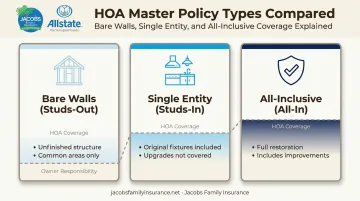
According to the Insurance Information Institute, some associations insure units as originally built, while others insure only bare walls, floors, and ceilings. Your unit's specific bylaws and the association's actual policy wording control this boundary, not general industry assumptions.
Your Responsibility as a Unit Owner (HO6 Policy)
Whatever the master policy doesn't cover becomes your job. That's where an HO6 policy fills the gap, covering interior finishes, personal belongings, and liability exposure.
Industry experts at IRMI note that condo and townhouse owners face a higher risk of major coverage gaps than buyers of almost any other personal insurance product. The reason is simple: most owners never read their HOA's master policy closely enough to know where their responsibility starts.
Before shopping for coverage, request two documents from your HOA:
- The master policy declarations page to see whether it's bare walls, single entity, or all-inclusive
- The governing bylaws to confirm how the association allocates responsibility for interior damage
Your Jacobs Family Insurance agent can review both documents alongside your HO6 policy to spot mismatches before they become a claims-time surprise.
What Does Condo Fire Insurance Cover?
A standard HO6 policy responds to fire damage in several distinct ways. Each coverage type handles a different part of the loss.
- Dwelling/interior coverage pays to repair cabinets, flooring, drywall, and fixtures damaged by fire, heat, or firefighting efforts, up to your policy limit
- Personal property coverage replaces furniture, electronics, clothing, and other belongings destroyed or damaged by fire and smoke
- Loss of use coverage pays for a hotel room, meals, and other additional living expenses if your unit is uninhabitable during repairs
- Personal liability coverage protects you if your negligence, say, an unattended stove, caused a fire that damaged a neighbor's unit
- Loss assessment coverage helps cover special assessments your HOA charges when its master policy deductible or limits fall short after a major fire
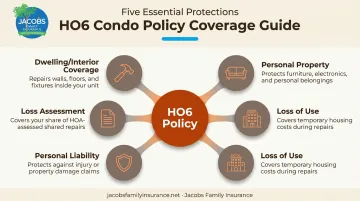
According to State Farm's breakdown of HO6 policies, dwelling coverage under a condo policy specifically includes interior-structure damage caused by smoke, not just open flame.
Smoke, Soot, and Firefighting Water Damage
Fire is a named peril on virtually every standard condo policy, and that same coverage typically extends to soot and water damage from firefighting efforts.
Insurers can still dispute the extent of cosmetic damage or lingering odor, so document everything thoroughly before assuming a "minor" smoke smell claim will be approved without evidence.
What Is Not Covered by Condo Fire Insurance?
Fire insurance has limits, and knowing them now saves you from a nasty surprise later.
Excluded or limited items typically include:
- Damage to the building's exterior, structural framing, or common areas, which falls under the HOA's master policy
- Losses caused by neglect, poor maintenance, or intentional acts
- Amounts exceeding your dwelling or personal property coverage limits
- Water damage unrelated to firefighting, such as flooding, which requires a separate flood policy
Underinsurance is the quiet danger here. Your HO6 policy only pays up to the limit you selected. If your unit's interior improvements or belongings are worth more than your coverage limit, that difference comes straight out of your pocket.
What Types of Fire Insurance Coverage Are Available for Condos?
Not all HO6 policies are built the same. Understanding your options helps you match coverage to your actual risk.
Named-peril vs. open-peril personal property coverage:
- Named-peril policies only pay when the loss matches a peril specifically listed in the policy
- Open-peril (all-risk) policies cover direct physical loss unless specifically excluded, offering broader protection
- Ask your agent whether your HO6 defaults to named-peril or open-peril, since many condo declarations don't specify this clearly
Beyond personal property, dwelling coverage limits, often labeled Coverage A or unit improvement limits, can usually be adjusted to match your HOA's studs-in, studs-out, or all-in designation. If your association only insures bare walls, you'll want higher interior coverage limits than someone whose HOA carries an all-inclusive policy.
Common optional add-ons include:
- Scheduled personal property coverage for jewelry, art, or collectibles above standard limits
- Excess liability or umbrella coverage for added protection beyond your base liability limit
- Loss assessment coverage reimburses your share of HOA-levied costs after a shared-area fire
Coverage needs vary depending on your specific HOA's policy type and New Mexico's requirements. Jacobs Family Insurance, an Allstate Elite Agency serving Santa Fe and Northern New Mexico, works with condo owners to tailor coverage limits to their association's actual bylaws rather than generic assumptions.
How Does Condo Insurance Work After a Fire? Steps to Take
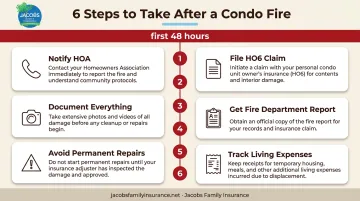
The steps you take in the first 48 hours after a condo fire can determine how smoothly your claim goes.
- Notify the HOA immediately and request a copy of the master policy to clarify coverage boundaries before filing your own claim
- File your HO6 claim promptly. Most policies require prompt notice, so don't wait to see what the HOA's insurer decides first
- Document everything. Take photos and videos of all damage, and pull together a personal property inventory if you have one
- Get a fire department report. Keep the incident report number on hand for your insurer
- Avoid permanent repairs until an adjuster has inspected the damage
- Track temporary living expenses, keeping every receipt for hotels, meals, and related costs
If coverage responsibility becomes unclear between the HOA's insurer and your personal insurer, follow up with both.
Gaps in communication between two insurers are exactly how disputes drag on for months.
Frequently Asked Questions
How does condo insurance work after a fire?
Both the HOA's master policy and your HO6 policy may respond, depending on where the damage occurred. Notify the HOA and file your own claim promptly to avoid delays.
What does condo fire insurance cover?
A standard HO6 policy covers interior dwelling damage, personal property, loss of use, and personal liability. It also includes loss assessment coverage for HOA-related charges.
What is not covered by condo fire insurance?
Common areas, structural elements, and damage from negligence or poor maintenance are typically excluded. Amounts above your policy limits also aren't covered.
What types of fire insurance are available for condos?
HO6 policies come in named-peril and open-peril forms, with open-peril offering broader protection. Optional add-ons include loss assessment coverage and umbrella liability.
Do I need fire insurance for a condo if the HOA already has a policy?
Yes. The HOA's master policy alone won't cover your interior finishes, personal belongings, or liability exposure. A personal HO6 policy is essential.
How much condo fire insurance coverage do I need?
Review your HOA's studs-in, studs-out, or all-in designation first, since it determines your interior coverage responsibility. A professional coverage review helps avoid underinsurance.
Ready to check your condo's coverage for gaps? Jacobs Family Insurance helps Santa Fe and Northern New Mexico condo owners review their HOA's master policy alongside their personal HO6 coverage. Call (505) 557-2067 or visit the office at 1547 South St. Francis Drive, Santa Fe, NM 87505, Monday through Friday, 9 AM to 5 PM, for a free policy review.